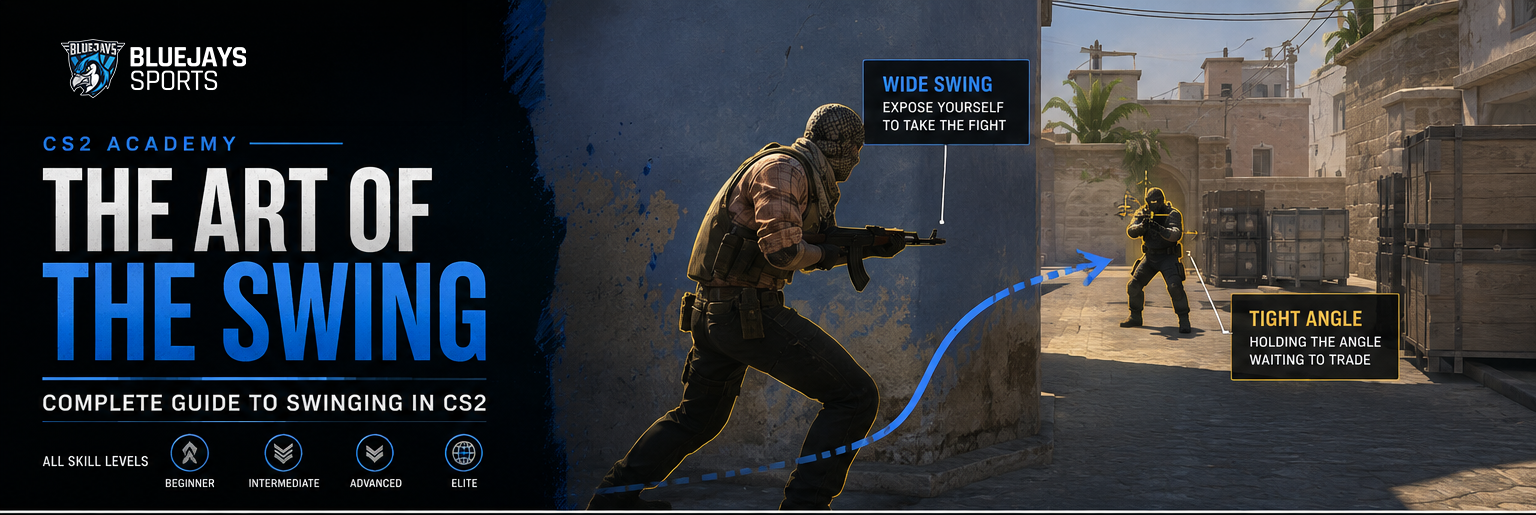
What Does "Swing" Actually Mean in Counter-Strike 2?
"Swing him!"
It is one of those calls you hear constantly in Counter-Strike. Your teammate spots an opponent, someone calls for the swing, and suddenly two players come flying around the corner.
But swinging is much more than simply holding A or D and hoping your aim does the rest.
A good swing combines movement, crosshair placement, timing, information and confidence. Used correctly, it can turn a difficult duel into a fight heavily stacked in your favor.
Used incorrectly, it is also one of the easiest ways to donate an AK to the enemy team.
Welcome to the BLUEJAYS CS2 Academy. Today, we are breaking down one of Counter-Strike's most important fundamentals.
What Is a Swing in CS2?
A swing is an aggressive sideways movement out from behind cover with the intention of taking a fight.
The key difference compared to other types of peeks is commitment.
A jiggle peek is primarily used to gather information.
A shoulder peek can bait a shot.
A swing usually means:
We are fighting.
You move away from cover, expose yourself to the opponent and prepare to stop and shoot.
Sounds easy? The difference between a good and bad swing becomes obvious very quickly.
The Standard Swing
Let's start with the basic version.
You know or suspect that an opponent is holding an angle. Instead of slowly walking into their crosshair, you move sideways around the corner and challenge them.
The important part happens before you even see the enemy.
Your crosshair should already be positioned where you expect their head to appear.
You do not want this:
Swing → Find enemy → Move crosshair → Stop → Shoot
You want:
Pre-aim → Swing → Stop → Shoot
Removing unnecessary actions makes your first bullet significantly faster.
The Wide Swing
Now we get to everyone's favorite version: the wide swing.
Instead of appearing around the corner and stopping almost immediately, you continue moving further into the open before taking the fight.
This can be incredibly effective because many players hold their crosshair relatively close to the edge of a wall.
A small peek may move directly into their crosshair. A wide swing suddenly forces them to adjust.
They have to track you or make a larger flick. Against the right opponent, that small difference can completely change the duel.
There is one major downside:
You are committed.
The further you swing, the harder it becomes to simply return to cover.
A wide swing should therefore be a deliberate decision, not your default movement around every corner.
The Double Swing
Counter-Strike becomes much easier when you stop trying to take every fight alone.
Enter the double swing.
Two teammates challenge the same opponent at almost the same time.
Suddenly the defender has a serious problem. They see two targets, but they can only place their crosshair on one.
Even if the first player dies, the second player should be in position to immediately secure the trade.
This creates one of the fundamental principles of competitive Counter-Strike:
Never give your opponent isolated 1v1 fights if you can create a 2v1 instead.
At higher levels, players constantly try to manipulate situations into favorable numbers. A coordinated double swing is one of the simplest ways to achieve exactly that.
Don't Swing Through Your Teammate
There is one small problem: player collision exists.
If two teammates try to explode through the same tiny doorway simultaneously, things can get ugly very quickly.
One player gets blocked. The second loses momentum. Everyone starts spraying. The enemy gets two kills.
Instead, create separation.
One player can take the closer line while the other swings wider.
Now the opponent not only sees two targets, but also has to make a larger crosshair adjustment between them.
That is exactly what you want.
Trading: Timing Is Everything
You have probably heard players talk about "trading".
A trade happens when an opponent kills your teammate and you immediately kill them in return.
Sounds straightforward, but the word immediately matters.
Imagine your teammate swings. They die. You wait one second, two seconds, three seconds, then you peek.
That is not really a trade attempt anymore.
The enemy had enough time to reset their aim, reposition or even escape completely.
Good trading requires you to stay close enough to your teammate to punish the opponent almost instantly.
Understanding Peeker's Advantage
Why do aggressive players sometimes appear ridiculously fast?
Welcome to one of Counter-Strike's most discussed topics: peeker's advantage.
CS2 is an online multiplayer game. Information has to travel between players and the server.
Because of latency and networking, the player actively moving around a corner can sometimes perceive the engagement differently from the player holding the angle.
The peeking player also has another important advantage: they decide when the fight starts.
The defender might have been staring at the same corner for 15 seconds.
The attacker knows:
I'm swinging now.
That combination of timing, pre-aim and online networking can make aggressive peeks extremely difficult to react to.
It does not mean the peeker automatically wins, but it helps explain why confidently swinging an angle can sometimes be more effective than slowly creeping into someone's crosshair.
Distance From the Corner Matters
This is where things become more advanced.
The distance between you and the corner changes what both players can see.
As a general principle, the player positioned further away from the corner can often gain a visibility advantage over someone standing extremely close to it.
Think about every duel as three points:
You → Corner → Opponent
Do not only think about where the enemy is standing. Think about your own distance from the corner.
Sometimes taking a few steps backwards before peeking can improve the angle considerably.
Swinging Against an AWP
An AWPer holding an angle wants one thing: a predictable target.
Slowly walking into their crosshair is usually exactly what they are hoping for.
There are several ways to make their life harder.
- Wide swing
- Flash
- Double peek
- Force them to shoot first
This is where a shoulder peek can become extremely useful.
Show just enough movement to bait the AWP shot.
BOOM.
Now go.
That missed shot creates a timing window where the AWPer needs to recover, reposition or switch weapons.
Use Your Utility
You paid for those grenades. Use them.
One of the biggest mistakes players make is constantly taking dry aim duels even when they have full utility available.
A simple flashbang can completely change the probability of winning a swing.
Instead of:
Swing → Hope
Try:
Flash → Pop → Swing
Now your opponent has to react to the flash while you already know exactly when the fight is coming.
This becomes even stronger when coordinated with teammates.
One player throws the flash. Another swings.
The defender has significantly more information to process in a very short amount of time.
Overload the opponent with problems.
When You Should NOT Swing
This might be the most important part of the entire guide.
You do not have to swing.
Imagine your team is winning 4v2. The bomb is planted. You have good post-plant positions. The opponent has almost no time.
Then someone hears a footstep.
"I HEARD HIM!"
Swing. Dead.
Now someone tries to trade. Swing. Dead.
Suddenly your comfortable 4v2 becomes a 2v2 and everyone starts wondering what happened.
Counter-Strike is full of rounds lost because players take unnecessary fights.
Sometimes the best play is incredibly boring.
Stay where you are.
Common Swinging Mistakes
1. Swinging Without Pre-Aiming
If your crosshair is pointing somewhere random, you are giving the opponent unnecessary time. Know what position you are clearing before exposing yourself.
2. Exposing Too Many Angles
A huge swing might help against one opponent while exposing you to three additional positions. Try to isolate fights whenever possible.
3. Swinging Without Information
If an enemy could be standing in five different positions, committing to one angle is a gamble. Use utility, sound and teammates to reduce uncertainty.
4. Trading Too Late
If your teammate dies and you wait several seconds before peeking, the opponent has already reset. Stay close enough to trade.
5. Becoming Predictable
Wide swinging every round is not aggressive genius. It is a pattern, and good opponents punish patterns.
Sometimes jiggle. Sometimes shoulder. Sometimes swing. Sometimes don't peek at all.
Jiggle Peek vs Shoulder Peek vs Swing
Jiggle Peek
Quick movement designed primarily to gather information while minimizing exposure.
Shoulder Peek
A small movement often used to bait a shot, particularly against an AWP.
Swing
A more committed movement designed to actively challenge the opponent.
Wide Swing
A larger aggressive swing designed to move beyond the defender's initial crosshair placement.
Each is a tool. The important skill is not simply knowing how to perform them. It is knowing when to use which one.
How to Practice Swinging in CS2
1. Crosshair Placement
Keep your crosshair at head level. Learn common positions and pre-aim before exposing yourself.
2. Movement
Practice moving sideways, stopping cleanly and firing accurately. Your first accurate bullet should come as quickly as possible after your movement stops.
3. Map Knowledge
The better you understand common defensive positions, the easier aggressive peeking becomes.
Deathmatch can also be extremely useful if you practice deliberately.
Do not only chase kills. Pay attention to how you enter every fight.
- Was your crosshair ready?
- Did you stop correctly?
- Did you expose yourself to unnecessary angles?
- Could you have approached the corner differently?
Every death can teach you something.
Beginner, Intermediate, Advanced and Competitive
Beginner
Focus on movement and crosshair placement.
Intermediate
Focus on pre-aim, different swing distances and trading.
Advanced
Focus on timing, angle geometry and opponent habits.
Competitive
Focus on coordination, utility and creating unfair fights.
At this level, the goal is not to prove that you have better aim. The goal is to make raw aim matter as little as possible.
Why take a 50/50 duel when good coordination can turn it into a 70/30?
Make the Fight Unfair
That is ultimately what good Counter-Strike is about.
A swing is not simply aggressive movement. It is a tool.
Combine it with good crosshair placement. Combine it with information. Combine it with utility. Combine it with another teammate.
And most importantly, understand when you should not use it at all.
The next time someone calls:
"Swing with me!"
Do not just run around the corner.
Think about the angle. Think about your spacing. Think about the opponent's crosshair. Think about the trade.
Then make the fight as uncomfortable for your opponent as possible.
Because the best Counter-Strike players do not only win their duels.
They create better duels in the first place.